Archive for September, 2010

Asher Brown Suicide: Parents Speak Out Against Bullying

By AAyles on September 30th, 2010

Asher Brown was a 13-year-old boy who, like most young boys, enjoyed reading, playing outside and hanging out with his dad. His mom said he seemed sad and withdrawn in the months leading up to his suicide this week and most of his sadness was contributed to bullying at school.

Asher’s parents say that their son was bullied at school for countless reasons. In addition to being gay, their son was bullied for being small, not wearing name-brand clothing, not using iPods and choosing to read instead of listening to music. “He wasn’t interested in those things,” said his parents in an interview with CNN today. “We could have bought it for him, we asked him if he wanted them and he said no, there are more important things.”

Asher shot himself in the head after almost 2 years of bullying. He told his parenst he was gay the morning of his death. 

The young boy’s parents are speaking out in hopes of raising awareness to issues like bullying in schools. They insist they reported the issue to Asher’s school but the school denies any reports of bullying with Asher, or any other student in the school.

Suicide as a result of bullying in teens and young children is becoming more and more of a problem. In the last 3 weeks, 3 young boys (Asher, Tyler Clementi and Seth Walsh) have committed suicide as a result of bullying.

If you think your child may be a victim of bullying, talk to them and take appropriate actions.

“Please if you have children that you think may be bullied, if they seem sad or withdrawn and you ask questions and they say ‘I’m fine’ push past that. Push past the ‘I’m fine,’” says Asher’s mom in the exclusive interview. “It’s extremely important. These kids are worried about retribution for speaking up. Not only speaking up for themselves but for their friends that are getting picked on.”

3 boys in 3 weeks. When will this end?


Playgrounds need trained staff to curb bullying

by Kim Schlender

September 27, 2010

As the kids go back to school and I hear the school bells ring, I think back to nearly 10 years ago, when I applied to be the playground lady at a nearby elementary school.

After a few days of being on the playground with 200-plus students, two monitors and one volunteer parent, I asked the principal what the student-to-supervisor ratio was. He looked at me strangely and said there wasn’t one. He said there were no state-mandated standards. I also learned that there was no training offered to the playground staff, other than CPR.

How many times have we heard that bullying starts on the playground? And here I found myself on that playground with no training, no disciplinary options and no support. Over the three-plus years I suggested several times that we bring in some trainers, meet with district social workers or at least put a behavior plan in place that would give us some authority. The message I got was that it wasn’t a priority.

Clearly I could not watch so many children and see everything. I made sure that I was visible to the kids, and I watched for the kids who seemed to be alone and those who seemed troubled day after day.

I noticed many of those kids would stay near me, which created a safety net of sorts. Many were also eager to talk and just have someone know who they were.

Then, of course, there were the troublemakers. I hoped that if I kept an eye on them and they knew it, they would make better choices. Often it actually worked. I was even able to catch them doing something good from time to time.

What frustrated me the most was that some kids seemed to think they could do and say whatever they wanted to. The attitude seemed to be that they could tease, taunt, be mean and tell other kids what to do. Often these were the popular kids, who had a group of followers. It seemed they were kings and queens of the playground.

Of course they were told to be nice — but remember, we had no guidelines on how to discipline or work with these kids. There were no real consequences and the kids knew it.

What kept me coming back was that, overall, the kids were kind and respectful and really wanted to do the right thing. And the volunteer parents really made a difference by being present.

Perhaps we don’t need to legislate ratios and standards, but we should recognize that playgrounds are understaffed and that they need trained, caring people to watch over our children. The playground should not be a scary or unsafe place. We can help kids make good choices about how they treat others by putting some time and resources into ensuring that the playground is a great place for kids and the adults who care for them.

I would encourage those who can to volunteer on a playground or in a lunchroom. Better yet, work with the PTO or site counsel at your school to get some training for the playground staff. And better still, model and teach your kids to be kind and respectful to others.


Depression and Bullying

By: Jeff Muise

(HealthDay News) — The adolescent victims of cyber bullying report higher levels of depression than do the bullies themselves or bully-victims, but this is not the case with traditional forms of bullying, according to a study published online Sept. 22 in the Journal of Adolescent Health.

Jing Wang, Ph.D., of the National Institutes of Health in Bethesda, Md., and colleagues analyzed data from the Health Behavior in School-Aged Children 2005 Survey that was administered to a nationally-representative sample of 7,313 students in grades six to 10. The researchers compared the incidence of depression among children who were bullies, victims, or bully-victims by the traditional definitions (physical, verbal, and relational bullying) and cyber bullying.

The investigators found the prevalence of physical, verbal, relational, and cyber bullying to be 21.2, 53.7, 51.6, and 13.8 percent, respectively. Depression was associated with all four forms of bullying, but the victims of cyber bullying reported higher depression than did the bullies or bully-victims, a result the researchers did not find with the traditional forms of bullying. For the three traditional types of bullying, frequently-involved victims and bully-victims had significantly higher depression levels than occasionally-involved victims and bully-victims. For cyber bullying, however, differences were found between occasional and frequent victims only.

“Notably, cyber victims reported higher depression than bullies or bully-victims, which was not found in any other form of bullying. This may be explained by some distinct characteristics of cyber bullying. For example, unlike traditional victims, cyber victims may experience an anonymous attacker who instantly disperses fabricated photos throughout a large social network; as such, cyber victims may be more likely to feel isolated, dehumanized or helpless at the time of the attack,” the authors write.


Bullying harms both victim and perpetrator

Sydney, Sep 19 (IANS) It’s not just the victim of bullying who faces psychological problems. Being a childhood bully can lead to relationship issue later in life.

‘Bullies go onto have lots of relationship issues. They have difficulty in romantic relationships,’ says Associate Professor Marilyn Campbell from the Queensland University of Technology, Australia.

‘Only people who are scared of them are their companions, their henchmen, in primary school,’ adds Campbell.

A 2006 study said that ‘bullies in primary school have been shown to be more likely to be convicted of a criminal offence before they reach their 20s than children who are not involved in bullying.’

‘They also often have drug and alcohol misuse problems because they self-medicate as they haven’t figured out how to have good relationships,’ it said.

Campbell said bullying was a learnt behaviour and that children learned from their families how to be bullies, said a Queensland release.

Punishing bullies has been shown not to decrease their bullying behaviour. The best way to stop bullying behaviour is by talking with bullies.

A second method is restorative justice where the bully must face the victim and the damage they have done.

‘These methods aim to elicit or teach the empathy that bullies lack,’ the release said.

Campbell said schools told children through their anti-bullying programmes that it was a bad thing to do.

However, if parents themselves bullied then this was not enough to change their children’s behaviour.

‘Bullying can only be stopped when the whole family is assisted to understand their behaviour and develop good social relationships,’ she said.

‘When children see domestic violence, which can be both physical and emotional abuse, they see that unequal power can be used to get your own way.

‘Parents may talk at the dinner table about their own bullying behaviour in the workplace and children pick that up as a method of getting what you want. On top of this, lots of media show that bullies win. Bullying is a deeply embedded social relationship problem.’

1 Comment more...

Teen suicide victim remembered by hundreds

Hundreds gathered outside the Greensburg Courthouse for a candlelight vigil to remember 15-year-old Billy Lucas.

By Tisha Lewis Fox59
Greensburg, Ind. —

Hundreds gathered outside the Greensburg Courthouse for a candlelight vigil to remember 15-year-old Billy Lucas.

Lucas reportedly hung himself last week after friends say he was the target of continual bullying at Greensburg High School.

“They called him dumb, they called him gay and what else I’ve said.  They pushed him into lockers and hit him and pulled his hair and tripped him all the time, ” said best friend Bryce Thacker in an interview with Fox 59’s Tisha Lewis.

Thacker said he was constantly defending Lucas, until he too was threatened for defending what Thacker says bullies described as “the gay boy.”

“He came here in fourth grade and he was harassed from the time he was in fourth grade and on…” said former classmate Bobbi Guinlan.

Friends and complete strangers held fliers reading, “It’s because of people in school who pretended they knew nothing and did nothing to help stop it.”

According to Guinlan, “We organized this to show how important it is because we don’t feel like our school corporations are doing anything about bullying really.”

Several parents describe a “culture of bullying” within the Greensburg School District.

The principal at Greensburg High School where Lucas attended says the school was not aware the 15 year old was a victim, though several parents dispute that assertion.

Fox 59 News has learned the school is “looking to establish a committee to address bullying” concerns, according to administrators.

1 Comment more...

Lakeland boy with Tourette’s tells his story

By WALT BELCHER | The Tampa Tribune

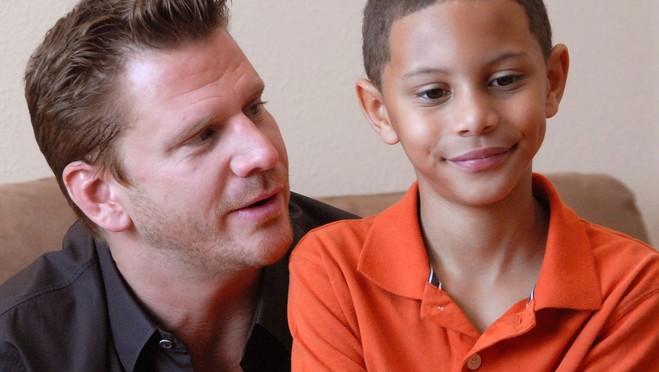
Jaylen Arnold, of Lakeland, started an anti-bullying campaign that is inspiring people across the country. One of his biggest fans is actor and musician Dash Mihok.

Jaylen Arnold has turned his personal battle with Tourette’s syndrome into a public battle against bullying.

The 10-year-old Lakeland boy has been dealing with the disorder since he was diagnosed as a toddler.

Tourette’s affects its victims differently. For Jaylen it causes uncontrollable tics and twitches. He has also been diagnosed with obsessive-compulsive disorder and Asperger’s syndrome, a form of autism.

“When I see myself, I see this twisty boy who is going crazy and then I look at other people and I feel like I am the only one who has this. … There’s something inside of me and I want it out,” he says in a touching and inspiring documentary debuting at 9 tonight on the Discovery Health cable network.

Jaylen is one of four children profiled in “Tourette’s Uncovered.” The program shows what parents and children face when their lives are dominated by a condition often misunderstood by the public.

In addition to being mocked and sometimes tormented by classmates, these children also must deal with physical pain and depression.

Jaylen’s mother, Robin, says that her son has “a lot of sensory issues,” such as being unable to stand the touch of rough fabrics. He can only wear soft cotton. He can’t stand to eat soft foods. He struggles to walk on grass in bare feet.

In addition to an uncontrollable desire at times to contort his body, he must wipe off any area that has been “tapped on” by someone’s fingers.

Cameras record his despair over the inability to go to bed at night because every inch of his body can’t stand to lay still.

As he pleads just to be a normal kid and have some happiness, his mother tries to comfort him.

His mother says they try everything possible from massage therapy to monitoring his diet to using vitamin supplements. “I want to do everything I can to make him more comfortable and protect him,” she says.

“What Tourette’s puts me through makes me like really sad,” Jaylen says. “It puts me in pain and literally hurts me. It makes life a lot … harder.”

Two years ago, Jaylen found a new purpose when he started an anti-bullying campaign. He had seen and experienced first-hand what it can be like to be teased because you’re different.

He started speaking out against it in schools in an effort to explain to other children the effects of Tourette’s syndrome. He began passing out “Bullying No Way” bracelets and anti-bullying booklets.

Jaylen, who was profiled on the “CBS Evening News” last year, started a website www.jaylenschallenge.org that is devoted to ending bullying.


Paterson Signs Anti-Bullying Act, Admits Hitting Bully

Yesterday, Governor Paterson signed the Dignity for All Students bill into law. The law requires school districts to make their environments harassment- and discrimination-free (by way of codes of conduct and policies) as well as reporting instances of bullying to the State Department of Education. Paterson said, “Bullying and harassment have disrupted the education of too many young people, and we in government have a responsibility to do our part to create learning environments that help our children prosper. I am proud to sign this bill into law as it will help ensure that students are protected from harassment, discrimination and bullying at school grounds and at school functions.”

According to the governor’s office, “The bill explicitly prohibits harassment and discrimination of students with respect to certain non-exclusive protected classes, including, but not limited to, the student’s actual or perceived ‘race, color, weight, national origin, ethnic group, religion, religious practice, disability, sexual orientation, gender or sex.'” Paterson also shared an anecdote about his experience with bullying, “As one of the first legally blind students that was allowed into public school … I was a victim of that [bullying] many times… One day I got so upset, I took a metal lunch box… walked right into a classroom, right past the teacher who refused to do anything about it and hit this kid in the face.”

NYC adopted an anti-bullying act in 2008, but earlier this year, a student at a Queens high school was allegedly stabbed by another student (it was suggested that it was spurred by the victim’s bullying).

By Jen Chung in on September 9, 2010 9:42 AM


Keeping bullying out of our schools

Tuesday, September 7, 2010

Plenty of children — and some of their parents — will likely have butterflies in their stomachs as they approach the start of another school year this week.

It’s the kind of nervousness that goes away once everyone has settled into the new routine. Unless, of course, there’s a bully in the picture.

For many children who suffered at the hands of bullies last year, the dominant back-to-school emotion isn’t so much nervousness as abject dread.

Fortunately things are changing, as evidenced by the attention being given to this problem by area school districts. As Citizen reporters have spoken to school principals and superintendents about the opening of school, every one of them has drawn attention to the efforts under way to ensure that all students will find their schools to be hospitable environments.

The role of teachers and administrators and other school staffers is critical to the effort. But so, too, is the role of parents.

Most studies find the vast majority of children never report incidents of bullying and those studies also show that notifying parents when bullying is observed has been uneven.

Confronting the problem of bullying must be the beginning of an ongoing dialogue between parents and school officials. It is only through such follow-up that a parent can determine if appropriate steps are being taken to resolve the issue or, in some cases, whether law enforcement officials should be involved.

It is also important to bear in mind that having an anti-bullying policy on the books is one thing; changing school and teen cultures that have traditionally turned a blind eye to bullying is quite another.

Changing that culture starts with open discussions about what bullying is, and what students and teachers should do when they see it happening. In Gilford schools, for example Middle School Principal Marcia Ross said the students are being given an orientation on a new school culture initiative which revolves around the four words: respectful, resourceful, responsible and confident

Initiatives of this sort are important for the bullies as well as their targets. Some studies have found a link between bullying and later legal and criminal encounters as an adult. In one tracking study, 60 percent of those identified as bullies in grades 6 through 9 had at least one criminal conviction by age 24.

Lesson one for the 2010-2011 school year is how students and teachers can know bullying when they see it, and stop it before someone gets hurt.


Why anti-bullying programs fail

Posted by James Alan Fox, Crime and Punishment August 31, 2010 11:15 AM

With the start of the school year fast approaching, millions upon millions of students are soaking up the last few days of summer. For some, however, a return to school means having to face once again harassment in the hallway and bullying on the bus.

Although the Internet may have broadened the scope, harassing behavior — from teasing to intimidation, from shoving to fighting — has been a problem for decades, if not centuries, likely for as long as there have been schools. Previously dismissed as normal and relatively harmless child’s play — “boys being boys,” “girls being catty” — in recent years bullying has taken on an entirely different meaning. Not only do victims tend to experience higher rates of illness and depression, but, some have resorted to suicide or murder as a last resort relief from constant harassment.

The suicide last January by 15-year-old Phoebe Prince, a high school student in South Hadley, Massachusetts, is but one of many episodes of senseless tragedy apparently precipitated by bullying and harassment. Eric Mohat of Mentor, Ohio, was harassed so mercilessly that when a one of his tormentors said out loud in class, “Why don’t you go home and shoot yourself, no one will miss you,” he did just that. And Luke Woodham who killed two classmates and wounded seven others in Pearl, Mississippi, wrote in what was meant as a suicide note, “I am not insane! I am angry. I kill because people like me are mistreated every day. I do this to show society—push us and we will push back. I have suffered all my life. No one ever truly loved me.”

For too many years, schools often responded to reports of bullying by placing the blame on the shoulders of victims, implicitly assuming that they were somehow responsible for their own victimization, if only because they failed to stand up for themselves. In cases where a student had to be transferred from one class or homeroom to another to prevent further harassment, it was usually the victim and not the bully who was displaced.

In the past couple of decades, however, school administrators have come to take — or have been compelled by law to take — a more progressive and enlightened view of the causes of and solutions to bullying. Rather than focusing just on the victims and offenders, schools have had far greater success by addressing the broader school climate.

Despite the range of promising tools for bullying suppression, there are significant hurdles to their successful application in school settings. Most of all, the school climate must be amenable to changing norms surrounding intimidation and aggression. Intolerance for acts of bullying must be the perspective widely embraced and shared by both faculty and students, not something merely imposed upon students by administrative decree.

Unfortunately, even when students and teachers appear, at least superficially, solidly unified against bullying, certain deeply-rooted prejudices that favor bullies over victims remain somewhat resistant to change. A study of perceptions and attitudes among middle school students and teachers in Pennsylvania found relatively weak confidence in the utility of anti-bullying curricula and role-playing strategies. Rather, both groups seemed to prefer an approach that encourages victims to be more assertive and to stand up for themselves. Apparently, the long-standing, “blame the victim” viewpoint suggesting that victims are in some way responsible for their mistreatment remains somewhat impenetrable.

Notwithstanding the widespread adoption of various school-based anti-bullying curricula, the empirical evidence with regard to their preventive value is somewhat disappointing. An analysis of anti-bullying interventions implemented over a 25-year time period, from 1980 to 2004, concluded that the effectiveness of bullying prevention programs was modest at best, and mostly impacted knowledge and attitudes rather than actual bullying behavior.

Regardless of the approach to prevention and enforcement, it remains extremely difficult to convince bullies that their actions are disadvantageous for themselves, besides being injurious to the targets of their abuse. Even with threats of punishment, some students see bullying as a positive thing — for themselves, that is.

All too often, bullies gain from their use of power over weaker classmates. Not only do they come away with their victim’s lunch money or property, but they are typically admired for their supremacy. Researchers at the University of Virginia found that bullies are, based on peer nominations, overwhelmingly considered to be the more popular students in class.

The problem of bullying and its solution goes way beyond the schoolyard. In our competitive society — in sports, in corporate America and especially in politics — we admire aggressors and pity pushovers. Sure, schools need to change, but so does society in general.

1 Comment more...

  • Bookmark and Share
  • Lindenhurst Bully Prevention

    Martial Arts Training

    Martial Arts Training

    For 20 years this martial arts school has been coaching people, of all ages, in the process of learning and practicing the martial arts as a tool for learning and practicing the art of being a more...

    Contact Now
    Brought to you by thumbtack.com
  • Growth and Education Blogs - BlogCatalog Blog Directory
  • Copyright © 1996-2010 Bully Prevention. All rights reserved.
    iDream theme by Templates Next | Powered by WordPress